

Skin tone balancing routine for clear skin in 2026
Most guys think uneven skin tone is just bad luck or genetics. The truth? It’s melanin dysregulation triggered by sun exposure, inflammation, and environmental stress. Your skin produces melanin unevenly across different areas, creating patches, dark spots, and general dullness. This guide breaks down exactly how to fix it with a practical routine that works for young men in 2026.
Table of Contents
- Understanding The Causes Of Uneven Skin Tone
- Core Steps For Effective Skin Tone Balancing
- Addressing Product Challenges: Tinted Moisturizers And Hydration
- Choosing And Applying Cosmetic Solutions To Enhance Skin Tone
- Discover Norml’s All-In-One Concealer For Men
- Frequently Asked Questions About Skin Tone Balancing
Key takeaways
| Point | Details |
|---|---|
| Root causes matter | Melanin dysregulation from sun exposure, post-inflammatory hyperpigmentation, melasma, and aging creates uneven skin tone. |
| Multi-step routines work | Cleansing, exfoliation with AHAs or BHAs, and serums containing Vitamin C or niacinamide effectively balance skin tone. |
| Know your skin type | Understanding your skin type prevents using products that are too harsh or ineffective for your specific needs. |
| Product interactions count | Tinted moisturizers oxidize due to skin pH, sebum, and iron oxide reactions, affecting appearance. |
| Maintenance is essential | Daily sunscreen and hydration sustain long-term skin tone balance and prevent new pigmentation. |
Understanding the causes of uneven skin tone
Your skin doesn’t wake up one day and decide to look uneven. It’s responding to specific triggers that mess with melanin production. Melanin is the pigment responsible for your skin color, and when it gets overproduced in certain areas, you see dark spots, patches, or general unevenness.
Uneven skin tone results from melanin dysregulation driven by several factors. Sun exposure is the biggest culprit. UV radiation damages skin cells and triggers melanocytes to produce excess melanin as a defense mechanism, leading to sunspots and darkened areas.
Post-inflammatory hyperpigmentation happens after acne, cuts, or any skin trauma. Your skin overproduces melanin during the healing process, leaving behind dark marks long after the wound heals. Melasma, often hormone-related, causes larger patches of darkened skin, typically on the face.
Aging compounds these issues. As you get older, melanin distribution becomes less uniform, and past sun damage accumulates, making uneven tone more noticeable. Young men often notice these changes earlier than expected because social media and close-up selfies highlight every imperfection.
Here’s what each factor does:
- Sun exposure: Triggers melanin overproduction in exposed areas, creating dark spots and uneven patches
- Post-inflammatory hyperpigmentation: Leaves dark marks after acne or skin injuries heal
- Melasma: Hormone-driven larger patches of darker skin, usually on cheeks and forehead
- Aging: Reduces skin’s ability to distribute melanin evenly, making past damage visible
- Environmental stress: Pollution and free radicals accelerate pigmentation irregularities
Understanding these causes helps you target the right solutions. If your unevenness comes from sun damage, you’ll focus on UV protection and brightening ingredients. If it’s post-acne marks, you’ll prioritize healing and pigmentation reducers. Check out common skin issues solutions men should know for more context on addressing specific problems.
“Melanin production is your skin’s defense mechanism, but when it goes into overdrive from repeated triggers like UV exposure or inflammation, it creates the uneven tone you’re trying to fix.”
Core steps for effective skin tone balancing
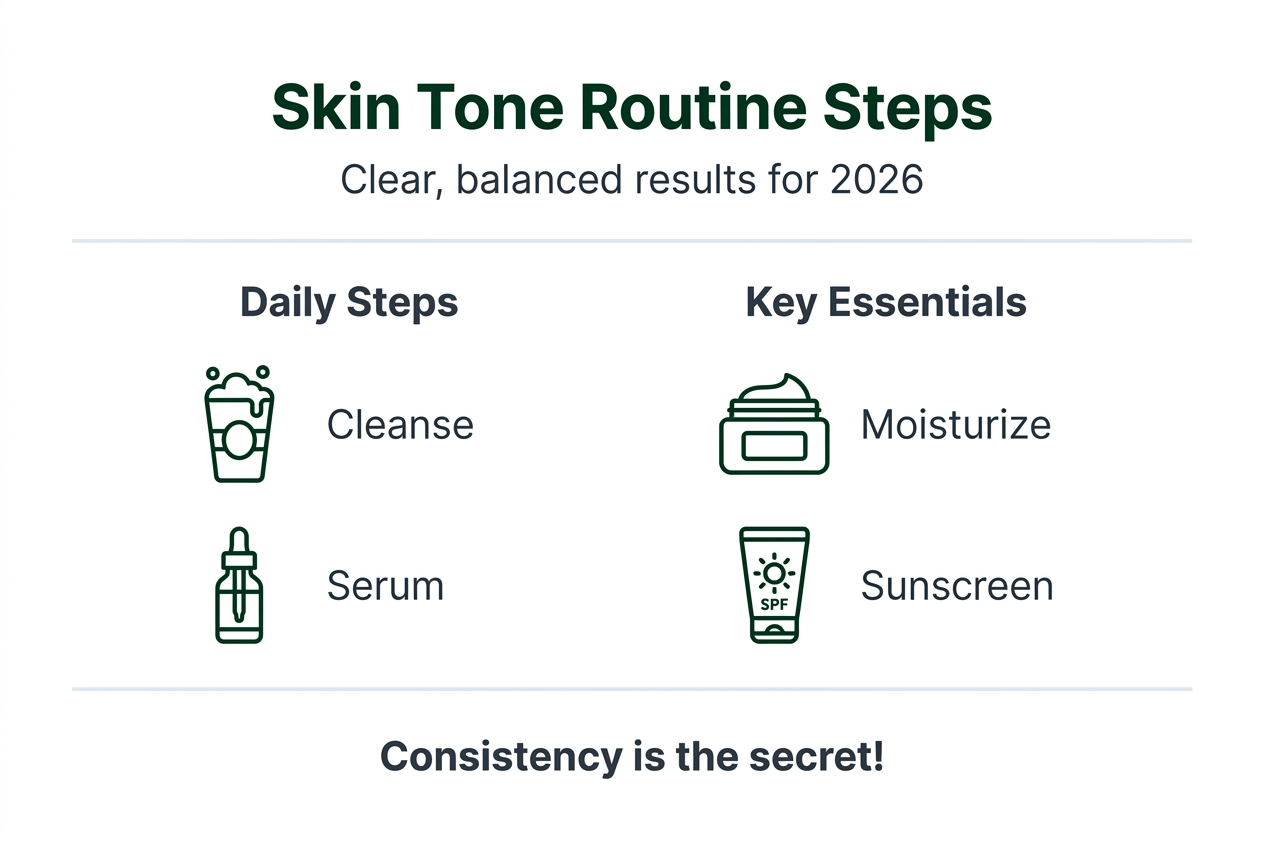
Balancing your skin tone requires a consistent routine that addresses multiple angles: removing dead skin, reducing pigmentation, and protecting against future damage. Effective skin tone balancing uses cleansing, exfoliation, and serums with specific active ingredients.
Here’s your step-by-step routine:
-
Cleanse gently twice daily: Use a mild, pH-balanced cleanser that removes dirt and oil without stripping your skin. Over-cleansing triggers more oil production and irritation, which can worsen pigmentation. Look for sulfate-free formulas designed for sensitive skin.
-
Exfoliate with chemical exfoliants: Skip physical scrubs. They create micro-tears and inflammation. Instead, use AHAs like glycolic acid or lactic acid to dissolve dead skin cells and reveal fresher skin underneath. BHAs like salicylic acid penetrate pores and work well for oily or acne-prone skin. Start with 2-3 times per week.
-
Apply targeted serums: This is where the real pigmentation work happens. Vitamin C serums brighten skin and inhibit melanin production. Niacinamide reduces inflammation and improves skin barrier function while lightening dark spots. Alpha arbutin specifically targets hyperpigmentation by blocking melanin synthesis. Use one or combine them, but introduce slowly to avoid irritation.
-
Moisturize to support skin barrier: Hydrated skin heals faster and maintains more even tone. Choose a lightweight, non-comedogenic moisturizer that locks in hydration without clogging pores. Ingredients like ceramides and hyaluronic acid strengthen the skin barrier.
-
Sunscreen every single day: This is non-negotiable. UV exposure undoes all your progress. Use a broad-spectrum SPF 30 or higher, even on cloudy days or when you’re indoors near windows. Reapply every two hours if you’re outside.
Pro Tip: Apply your serum to slightly damp skin right after cleansing. The moisture helps the active ingredients penetrate deeper and work more effectively.
Consistency matters more than expensive products. A simple routine done daily beats a complex one you skip half the time. For more guidance, explore men’s skincare best practices and men’s skin care tips for 2026.
Addressing product challenges: tinted moisturizers and hydration
You might use a tinted moisturizer to even out your skin tone quickly, but then notice it turns orange or darker throughout the day. Tinted moisturizer oxidation occurs when iron oxide pigments react with oxygen and skin enzymes, influenced by your skin’s pH, sebum composition, and environmental factors.
Several factors drive this color shift:
- Skin pH levels: Higher pH (more alkaline) accelerates oxidation reactions with pigments
- Sebum composition: Oily skin produces more sebum, which interacts with iron oxides and speeds up color change
- Environmental exposure: Heat, humidity, and pollution increase oxidation rates
- Product formulation: Lower-quality stabilizers or incompatible ingredients worsen the problem
- Application timing: Applying tinted products over active serums without proper wait time causes interactions
To minimize oxidation, let your serums fully absorb before applying tinted products. Wait at least 2-3 minutes between layers. Choose tinted moisturizers with stabilized pigments and silicone-based formulas that create a barrier against sebum.
Hydration plays a bigger role in skin tone balance than most guys realize. Hyaluronic acid provides hydration that supports skin function and healing. Well-hydrated skin sheds dead cells more efficiently, reducing dullness and allowing pigmentation treatments to work better.
Here’s how different factors affect tinted product performance:
| Factor | Impact on Oxidation | Best Practice |
|---|---|---|
| Skin pH | Higher pH increases oxidation by 40% | Use pH-balanced cleansers and toners |
| Sebum production | Oily skin accelerates color shift | Blot excess oil before application |
| Wait time between products | Immediate application triples oxidation risk | Wait 2-3 minutes between layers |
| Product quality | Low-quality formulas oxidize 60% faster | Invest in stabilized, silicone-based products |
| Environmental conditions | Heat and humidity double oxidation rate | Use setting powder in warm climates |
Pro Tip: If your tinted moisturizer consistently oxidizes, try a shade lighter than your skin tone. As it oxidizes throughout the day, it will darken to match your actual color.
For better results with cosmetic solutions, check out natural concealer tips and concealer routine steps designed specifically for men.
Choosing and applying cosmetic solutions to enhance skin tone
Skincare routines take weeks to show results. Sometimes you need an immediate fix for an important meeting, date, or event. That’s where concealers and color correctors come in. They’re not about looking like you’re wearing makeup. They’re about looking like the best version of yourself, right now.
Understanding your skin type matters before you choose any product. What works for dry skin might look cakey on oily skin. What works for fair skin won’t match deeper tones.
First, identify your undertone. Look at the veins on your wrist in natural light. Blue or purple veins mean cool undertones. Green veins indicate warm undertones. If you can’t tell or see both, you have neutral undertones. This determines whether you need peachy, yellow, or neutral-toned products.
Concealers and color correctors serve different purposes:
- Concealer: Matches your skin tone and covers imperfections like dark circles, blemishes, and redness
- Color corrector: Uses complementary colors to neutralize specific discoloration before concealer
- Tinted moisturizer: Provides sheer, all-over coverage with hydration
- BB cream: Combines skincare benefits with light coverage
- Stick concealer: Offers precise, buildable coverage for targeted areas
Color theory helps you neutralize specific issues. Orange or peach correctors cancel out blue and purple tones like dark circles and bruises. Green correctors neutralize redness from acne or rosacea. Yellow correctors brighten dull skin and correct minor discoloration.
Application technique makes or breaks the natural look. Less is more. Start with a tiny amount and build up if needed. Use your ring finger or a damp sponge to pat the product in, don’t rub. Blend outward from the center of the area you’re covering.
Discoloration patterns vary by demographics, which affects how you should approach color correction. Different skin tones have unique pigmentation challenges that require tailored solutions.
Here’s a comparison of common concealer types for different needs:
| Concealer Type | Best For | Coverage Level | Finish | Application Method |
|---|---|---|---|---|
| Liquid | All skin types | Light to medium | Natural | Fingertips or sponge |
| Stick | Targeted spots, blemishes | Full | Matte to satin | Direct application, blend edges |
| Cream | Dry to normal skin | Medium to full | Dewy to satin | Brush or fingertips |
| Powder | Oily skin, setting | Light | Matte | Brush over liquid concealer |
| Color corrector | Specific discoloration | N/A (used under concealer) | Varies | Fingertips, thin layer |
Set your concealer with a light dusting of translucent powder if you have oily skin or need it to last all day. Skip this if you have dry skin, as powder can emphasize texture.
For more on using cosmetic solutions confidently, explore skin tone correction confidence and the difference between men’s skincare vs makeup for your confidence.
Discover Norml’s all-in-one concealer for men
You’ve learned the science behind skin tone balancing and the routines that work. But what about those mornings when you need to look sharp in five minutes?

That’s where Norml all-in-one concealer comes in. It’s designed specifically for guys who want to cover blemishes, dark circles, and redness without anyone knowing you’re wearing anything. The formula is lightweight, matte, and blends seamlessly into your skin.
Whether you’re heading to work, meeting someone new, or just want to look more put together, Norml gives you that confidence boost in seconds. It works with your skin type and tone, not against it. Check out how to use concealer for simple application tips that take less time than making coffee.
Frequently asked questions about skin tone balancing
How long does it take to see results from skin tone balancing?
You’ll notice improvements in skin texture and brightness within 2-3 weeks of consistent exfoliation and serum use. Significant pigmentation reduction typically takes 8-12 weeks because skin cells turn over every 28 days. Deeper melasma or sun damage may require 4-6 months of dedicated treatment.
Can tinted moisturizers cause more skin problems?
Tinted moisturizers themselves don’t typically cause skin problems if you choose non-comedogenic formulas matched to your skin type. The main issue is oxidation making them look unnatural, or using them as a substitute for sunscreen when they don’t provide adequate SPF protection. Always use separate SPF underneath.
Is it necessary to use sunscreen every day to maintain even skin tone?
Yes, absolutely. UV exposure is the primary trigger for new pigmentation and makes existing dark spots darker. Even indirect sunlight through windows or on cloudy days causes damage. Skipping sunscreen will undo all your brightening efforts and create new uneven areas.
What should I do if my skin gets irritated by brightening products?
Stop using the product immediately and simplify your routine to gentle cleanser and moisturizer until irritation clears. When you restart, introduce one active ingredient at a time, starting with lower concentrations. Use brightening products every other day initially, then increase frequency as your skin builds tolerance.
How do I know my undertone for choosing makeup products?
Check your wrist veins in natural light. Blue or purple veins indicate cool undertones, green veins mean warm undertones, and a mix of both suggests neutral undertones. You can also consider whether silver or gold jewelry looks better on you. Silver flatters cool undertones, gold suits warm undertones.
Does diet affect skin tone balance?
Yes, diet impacts skin health indirectly. Antioxidant-rich foods like berries, leafy greens, and nuts support skin repair and protect against oxidative stress that worsens pigmentation. Hydration from water intake helps skin function optimally. However, topical treatments remain far more effective for directly addressing uneven skin tone than dietary changes alone.


